

Keep on Dubbing
Reflections on a decade in kitchens
Every time I cook polenta I think of Francisco. Baby-faced Francisco, nicknamed Panchito by our other poblano coworkers. Never saw him in a bad mood, muy amable, he worked the hot station with quiet confidence, the best of anyone. When he trained me on griddle he was hands-off, with a watchful eye. I kept finding the knobs cranked a little higher than I remembered leaving them. I thought I must be accidentally nudging them with my thighs and tried to pay more attention to that half of my body, but eventually realized he was gently tricking me into working faster.
Four quarts of water, one quart of polenta. Bring the water to a boil, add salt, but not as much as pasta water, way less than pasta water, because the corn’s going to absorb all of it. Stream the grain into the boiling water as you whisk, then turn the heat down, because it’s almost immediately going to thicken and turn into a burbling pit of hot corn lava. But don’t turn the heat down too much, just keep stirring, so it cooks quick without splattering you. These are my words, not his. He showed me and explained, but the only word I remember him saying is suave. That’s what the polenta granules should be, slightly translucent and clinging to the wires of the whisk, tasted carefully to assess texture and seasoning without burning your tongue. Suave happens in about ten minutes by the way, basta any nonna who tells you different.
I can’t sweep the floor without thinking of Francisco. Not Panchito, but El Loco, Francisco dominicano, pronounced skipping over the “s” like Franci-co. Impossible to guess his age, he’s charmingly sexist in the way only an older guy can pull off. A lot of what he says makes me double-take and our coworkers laugh and tsk, but my Spanish isn’t good enough to feel confident that I heard correctly, let alone to retort. He tells me that if I don’t get better at sweeping I’m never gonna find a husband.
When I sweep I also think of my first job in New York, in the basement of a bakery attached to a restaurant. My boss Lindsay--who taught me, before she quit, how to exist in a professional kitchen and singlehandedly produce an entire pastry menu--told me one morning I was forgetting to sweep at the end of my shift. I felt defensive, because I was sweeping, and what about the guy who came in to make pasta, throwing all that flour around after I left for the day? I also felt surveilled. I had learned I could pause to eat in the nook under the stairs, out of view of the security cameras, the same way Chamo the pasta guy figured he could make a pass at Lindsay in the walk-in. Was everyone talking about me and my shitty sweeping, or did the owner check the cameras?! But I’m sure the simplest explanation was true, and that I was in fact just doing a bad job, because I had never really swept a floor before.
After Lindsay put in her notice, she invited me for a drink. She told me she reported Chamo--she hadn’t been planning to say anything, but noticed that he had turned his focus to me after she rejected his advances. Her meeting ended up being with the Italian owner, the restaurant GM, the chef, the sous chef, and Chamo himself, all men speaking Spanish as she sat there trying to understand, trying to chime in. The owner excused the lunging attempted kiss as cultural differences, but eventually agreed to let him go. Weeks after Lindsay’s last day, Chamo sauntered back into the basement, a gleam in his eye, making a show of not speaking to me. I guess he was the only guy who knew how to make pasta.
When I’m so tired I feel like crying, I think of Ben. Over that beer with Lindsay, she advised me to ask for a raise at the bakery and also start looking for a new job. It was clear I would not be her successor--even though I had learned to execute her menu, I was a 22-year-old with six months of experience, total. Head baker Ben was going to help me out in the meantime, seamlessly keeping production afloat, while ownership worked on hiring a new pastry chef. Ben enthusiastically came to my assistance daily, even though it meant adding to his own heavy workload. He could carry four full sheet trays at once, splaying his fingers to space out the stack so as not to crush the trays’ delicate contents. When I expressed my awe, he winced cheerfully and confessed he had fallen down the narrow stairs doing so on more than one occasion.
I found and took a line cook job quickly, one that I was excited about, and that needed me to start full time right away. I would get home from my closing shift near midnight, and be back at the bakery by six the next morning. Meanwhile, the bakery seemed no closer to hiring a pastry chef than they were when Lindsay gave her notice. After a few weeks of these self-inflicted doubles, totally sleep deprived, some small frustration tipped me over the edge. I sank to the floor in the staff coat hall, starting to sob. Ben dragged me into the bathroom, hissing, “Do not let them see you cry. Do not let them break you.” I was taken aback by the swiftness and strength of his reaction.
When a squeeze bottle gets low, I think of Javier. Predictably, any time an almost-empty bottle made an embarrassing farting sound, especially in the middle of a rush, he would do a clown-horn style laugh followed by a genuine one. Haeh haeh! Was the laughter a deliberate training technique, a tool of coercion, or true potty-humor delight? Either way it worked--anyone would stay on top of refilling bottles to avert sonic mockery.
Javi and I hooked up a few times, the first time under the guise of doing laundry together on our shared day off, even though his place and laundromat were at least a mile away from mine. I remember thinking it was cute he had a loft bed, the ceiling a little close for comfort. Another time I ended up sleeping over, which was how I learned he proudly started each day with a regimen of “coffee, spliff, shit.” That morning we were both scheduled to open, and biked into Manhattan together, racing over the bridge. He showed me his zigzaggy route through the Lower East Side, which he assured me was the fastest, before we carefully staggered our arrivals.
When I hear dub reggae, I think of that one barista who played it every shift. Who is this? Oh, it’s King Tubby. Next day: Who is this?! Also King Tubby! Then I think of the other barista who, in addition to being the object of a vague crush I never acted on, had been a museum pastry chef in a past life. It was a trip trying to picture his wire-rimmed-glasses-Bill-Cosby-sweater-Brooklyn-hipster-ass in a spotless white coat and toque, high ceilings, blinding lights, tweezers, gold leaf, Vivaldi, fancy little pastries gleaming underneath glass cases, as pristinely presented as the art. But he needed better pay and sold out for the glamour of La Marzocco, and who could blame him? Now he’s reincarnated as a union glass worker, installing massive panels of glass at the top of skyscrapers. Same camaraderie, more adrenaline, even better money.
When I roll out pie dough, I think of Eva. She apologized for stealing my hours while I trained her on a job I couldn’t wait to quit. Turns out she once trailed at another place I used to work, and I heard from a friend there that she’d talked wistfully about wanting to freeze and sell her eggs. I didn’t understand at first. She has a chicken coop in Brooklyn?! Why would she need to freeze them!? But instead of making other people’s fertility dreams come true, becoming fabulously semi-rich with minimal effort, she was on the same grind as the rest of us.
When I soft-scramble eggs, I think of Lo. At a cafe and community event space, they devised a tight food menu, clever and sophisticated for a station that consisted of a single induction burner and a fridge in the back. We were slow, a camp-out-on-your-laptop type place despite everyone’s best efforts--I probably averaged a dozen plates in a six-hour shift, a few of them for staff. “I’m going to be stepping away from day-to-day operations,” said the 24-year-old one day, carefully imitating the words of a chef they must have had once. Okay, confirmed, it’s not just that I’m only a quarter-POC and not outwardly or fashionably queer, this idealistic workplace is actually toxic AF. Then COVID hit, and we all stepped away from day-to-day operations, indefinitely.
On the rare occasion I see a beautifully turned omelette, I think of Arón. Every Friday night we would crack two double-wide cases of eggs (that’s sixty-dozen) in preparation for the Saturday breakfast shift. Somehow I remember him holding three eggs in each hand, but I must be imagining that. Regardless, he could crack them about six times faster than I could. On weekend mornings we served breakfast tacos, eggs cooked diner-style, hot and fast. Arón worked the egg station alone, an eight-burner range covered in as many nonstick sautes. Once in awhile, in a brief moment of down time, he would take a ladleful of the same liquefied eggs and turn them into a perfect omelette, winking, just to remind himself and everyone else he could.
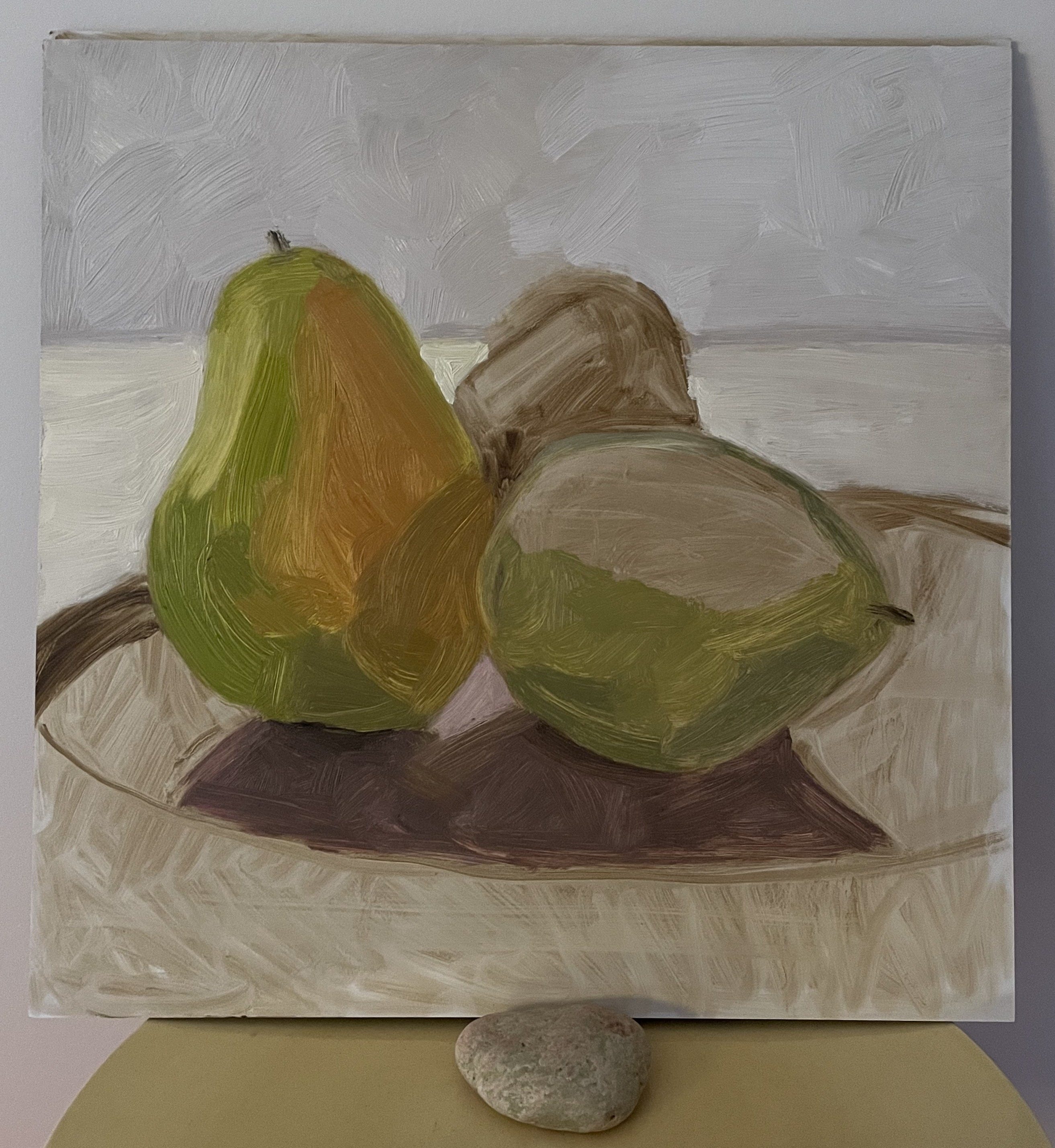
When I peel a perfect pear, I think of Brooks. One time I made a sorbet base, raw pears pureed with syrup, seasoned perfectly to go from tasting a-little-too-sweet to the-best-version-of-the-fruit. Satisfied, I put the mixture aside for a bit while I returned to the line to push out some tickets. Whoa whoa whoa where are you going?! Those pears are gonna oxidize like this, and no one wants tan sorbet, everyone will know you let it oxidize. He told me how his own pear awareness was raised by one of his first chefs, who was as aggressive with scolding as she was with congratulating. “Know what this sorbet would be good for? A fucking wedding.” Get it? ‘Cause it’s pure white.
Every time I perform a task that is now familiar and mundane, the same people and moments wear a deeper furrow into my neural pathways. The moments were small, and many of the friendships were brief, but intimate and tender and intense in the way only hours of physical proximity can foster. These memories and a thousand others are encoded in my body, in the muscle memory of repetitive movements. I’m tired, and I’m taking a break from kitchen work, as I seem to do every couple of years. But if I ever stop cooking, I’m terrified I’ll lose these memories forever.
lfg... felt like singing in the shower. especially loved the pearls of cooking wisdom (a la the texture of the polenta) that i as an at-home chef could pick up on, mixed in with the life pearls. more please
I love this. Every time I open a can of tomatoes, I think of the late Anne Burrell, who had me opening tomato cans on my first day as a prep cook at Italian Wine Merchants. She told me to rinse out the cans and I thought she meant to clean them for recycling, but she meant to add a little water and get the last dregs, so as not to waste anything. She was a little mean and a little funny about it, and I never did it again. Every time I crack and egg and get all the whites out with my fingers, I think of the late Tony Bourdain, because one of the ancient chefs, I forget whom, told him to do that on an early version of his TV show.